
The Infectious Disease Treatment Module (IDTM) is revolutionizing emergency healthcare delivery for infectious disease outbreaks. As a key component of the World Health Organization (WHO) and World Food Programme (WFP)-led INITIATE2 project, the IDTM is designed to provide rapid, effective, and dignified care to communities during the initial phases of an outbreak. Insights from the recent simulation in Accra have identified critical updates and refinements, propelling the IDTM closer to becoming a global standard for outbreak response.
Overview of the INITIATE2 Project
The INITIATE2 project unites emergency responders, researchers, and institutions to develop standardized, deployable solutions for global health crises. Central to this mission is the IDTM, which aims to provide a universally adaptable, patient-centered infectious disease treatment solution. With input from over 50 partners worldwide, the project seeks to create a go-to framework for addressing outbreaks efficiently and humanely.
The initiative emphasizes adaptability, resilience, and human-centered care, positioning the IDTM a flagship effort to meet the urgent demand for modular, rapidly deployable facilities tailored to infectious disease scenarios.
Guiding Design Principles
The IDTM’s design is underpinned by core principles that emphasize safety, adaptability, inclusivity, resilience, and user experience. Key considerations include:
- Infection Prevention and Control: Features ensure containment and protect both patients and healthcare workers.
- Rapid Deployment and Efficiency: Modular structures enable quick setup and transport, minimizing waste and maximizing reuse.
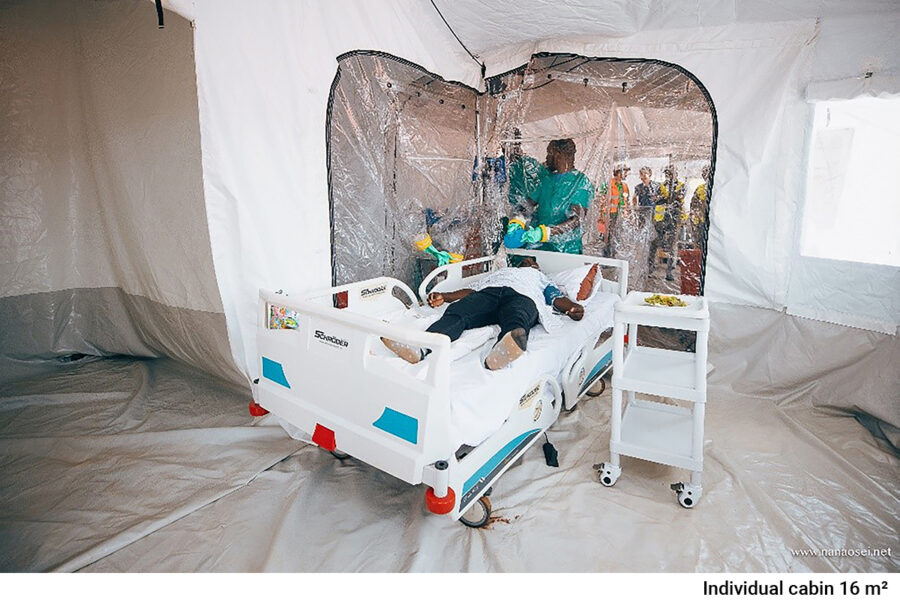
- Dignity and Comfort: Thoughtful layouts and transparent screens promote patient well-being.
- Cultural Adaptability and Climatic Responsiveness: Designs are tailored to local practices and weather conditions.
The IDTM prototype was collaboratively developed through WHO Téchne and the International Federation of Healthcare Engineers (IFHE), with contributions from organizations such as Mazetti, H.H. Angus, the University of Toronto, Carleton University, LS3P, and Parkin Architects. Parkin Principal Kyle Basilius served as the IFHE Volunteer Technical Architect, bringing healthcare design expertise and visionary leadership to the initiative.

Key Updates in IDTM 2.0
Building on earlier iterations, IDTM 2.0 introduces pivotal updates informed by real-world simulations:
Structural Enhancements
- Streamlined modular assembly for faster deployment and improved durability.
- Simplified windows, doors, and fasteners for ease of use.
- Reinforced vestibules to withstand adverse weather conditions.
Transparent Screens
- Enhanced rigidity and tension for better visibility and reduced contamination risks.
- New double-ring glove fastening system to minimize cross-contamination.
- Redesigned cable pass-through apertures for improved organization and infection control.
Advanced Power Systems
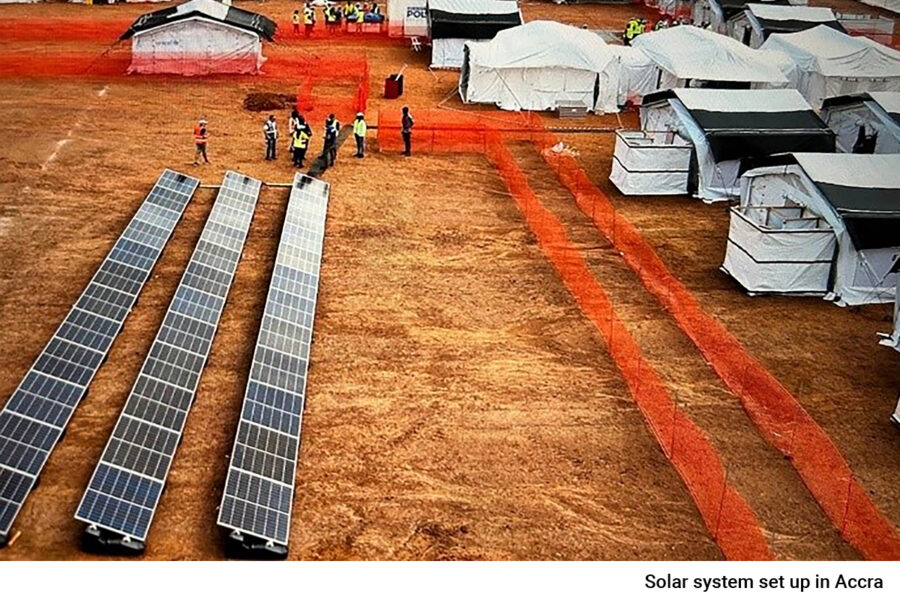
- A 15KW PV solar system with 8KW battery capacity, developed with UNICEF, WHO, and Selco Foundation, ensures reliable and sustainable energy.
Enhanced Flooring
- Durable, lightweight, and preassembled components for quicker setup and improved usability.
Additional Features
- Enlarged shadowing net for better thermal comfort.
- Refined packaging and labeling system for more efficient transport and assembly.
Simulation Outcomes and Feedback
The Accra simulation (November 11–15, 2024) involved a multidisciplinary team, including WHO, WFP, UNICEF, Médecins Sans Frontières (MSF), and ministries of health from Ghana, the Democratic Republic of the Congo, Guinea, Kenya, Malawi, Uganda, and other African nations. Key feedback included:
- Workflow Optimization: Improved layouts to enhance efficiency and reduce worker fatigue.
- Ventilation Systems: Enhanced air circulation for better infection control.
- Communication Tools: Integration of internal systems to streamline operations.
- Cultural Sensitivity: Adjustments to reflect local customs and preferences.
Areas for Further Development
Based on the simulation, the team identified critical areas for enhancement:
- Transparent Screens: Ergonomic refinements, improved cable management, and privacy features.
- Windows: Simplified installation, fixed mosquito nets, and improved drainage.
- Doors: Single-layer designs for easier handling.
- Packaging: Reduced box usage and pre-installed liners for quicker setup.
- Patient Comfort: Incorporation of local artwork and improved interior aesthetics.
Future Steps
The next phase of development will focus on refining the design and scaling production. Key objectives include:
- Conducting additional field tests across diverse geographic and cultural contexts.
- Collaborating with manufacturers to ensure cost-effective, scalable production.
- Engaging global health organizations to explore deployment opportunities.
- Finalizing technical specifications by February 2025.
A Vision for the Future
Reflecting on the Accra simulation, Parkin Principal Kyle Basilius stated:
“The IDTM represents a transformative leap in how we approach emergency healthcare, ensuring dignity, efficiency, and resilience in some of the most challenging environments.”
Through innovation and collaboration, the final iteration of the IDTM is poised to redefine emergency infectious disease response, delivering lifesaving care to vulnerable communities worldwide.